


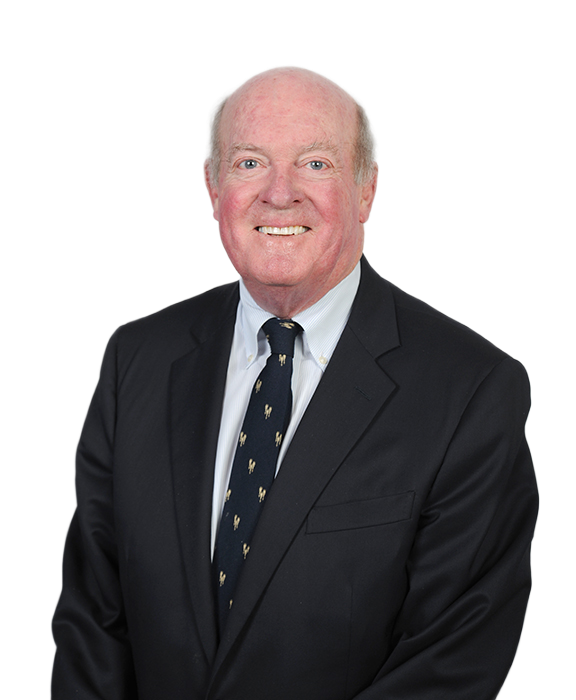
William F. Murphy is primarily engaged in employment and labor litigation and counseling, representing both employers and senior executives. He also represents businesses facing Telephone Consumer Protection Act (TCPA) claims and in other civil litigation matters. He manages the firm’s San Francisco office. Born in Aurora, Illinois, Bill received his A.B. magna cum laude in Economics from Harvard College and his J.D. cum laude from Cornell Law School, where he served as an editor of the Cornell Law Review. After law school, he was law clerk to the Hon Robert J. Kelleher, United States District Judge for the Central District of California in Los Angeles. He then became an associate attorney with the law firm then known as Pillsbury, Madison & Sutro in San Francisco. Prior to joining the firm, Mr. Murphy founded and managed the Dillingham & Murphy law firm in San Francisco for over 4 decades. He is admitted to practice in California.
Mr. Murphy’s practice focuses on employment and labor litigation, arbitration and counseling, as well as other civil litigation matters. He has substantial expertise in litigating and counseling in Title VII and California’s Fair Employment and Housing Act (FEHA) cases, as well as all other wrongful termination matters, unfair competition/trade secrets matters, representing chiefly (but not exclusively) employers and individual employee defendants. This includes defending cases such as class action wage & hour matters, whistle-blower cases, and sexual harassment cases. Bill’s civil practice also includes defending TCPA cases, defending and prosecuting unfair competition and trade secrets cases involving departing employees, and defamation claims. He also serves as a mediator on the Mediation Panel of the Alternative Dispute Resolution Program for the United States District Court for the Northern District of California, and as an attorneys’ fee dispute arbitrator for the California State Bar Association. Bill is recognized as a Super Lawyer (San Francisco) and is a member of the Federation of Defense and Corporate Counsel (FDCC). He has lectured and published numerous articles on employment-related matters. In college, he was an editor of the Havard Lampoon, the nation’s oldest continually published college humor magazine. He is a member of San Francisco’s Olympic Club where he occasionally pretends to golf.
RELATED PRACTICES
RELATED NEWS & PRESS
On October 1, 2026, the Fresno County Superior Court granted a motion for summary judgment in an employment discrimination case brought by a former Vons…
Share ThisThe New York firm combines with Dillingham & Murphy, establishing its first West Coast office at 155 Sansome Street. New York-based McLaughlin & Stern is…
Share ThisEDUCATION
- Harvard College, A.B. magna cum laude in Economics
- Cornell Law School, J.D. cum laude.
BIRTHPLACE
- Aurora, Illinois
BAR ADMISSIONS
- California
- Ninth Circuit Court of Appeals
- United States District Courts for the Northern, Eastern, Central & Southern Districts of California
MEMBERSHIPS
- Federation of Defense and Corporate Counsel (FDCC)
PUBLICATIONS AND HONORS
Super Lawyer (Employment, San Francisco – 2013 – present);
LAW PRACTICE AFTER THE PANDEMIC: THE ACTUAL & VIRTUAL WORLD FOR THE OFFICE AND THE COURTS” – presented at the International Network of Boutique Law Firms, Seaside, Florida, November 5, 2022;
“A Business Client’s Guide to Arbitration Agreements” Paradigm Magazine, Fall 2019;
“New California Employment Legislation for 2014: A Primer for Californians and Non-Californians,” FDCC Employment Practices & Workplace Liability Section Newsletter, January 2014;
“Copy This: California Law Regarding Access to Personnel Files,” FDCC Employment Practices & Workplace Liability Section Newsletter, June 2013;
“Will Healthcare Reform Put Employers in the Hospital? An overview of Healthcare Reform and Its Potential Impact on Employers,” USLAW Magazine, April 2010;
“To Be Continued: Ancient Claims Cannot Sneak in The Courthouse Door,” San Francisco Daily Journal, May 25, 2000, p. 5 [analysis of ‘continuing violation’ doctrine in California];
“Ties of Affection: Consensual Relationship Agreements Aren’t Love Potions,” San Francisco Daily Journal, January 6, 1999, p. 4 [analysis of suggestion that employers require co-employees who date to sign agreements regulating their workplace conduct].
NEWS & PRESS
On October 1, 2026, the Fresno County Superior Court granted a motion for summary judgment in an employment discrimination case brought by a former Vons employee against Safeway Inc. Partner Bill Murphy and Associate Adrienne Ou of the McLaughlin & Stern San Francisco office handled the briefing on the motion. Frank Mejia v. Safeway Inc., Fresno County Superior Court Case No. 24CECG05067.
Plaintiff’s employment terminated after Safeway management determined that an investigation of a workplace altercation involving Plaintiff and a co-worker showed that Plaintiff had violated Safeway’s anti-workplace violence policy. Plaintiff’s union initially grieved the termination under the collective bargaining agreement, but later withdrew the grievance, conceding the Company had good cause to terminate Plaintiff’s employment. Plaintiff’s lawsuit challenged the grounds for his termination, arguing he did not violate Safeway policy and alleging instead that he was terminated because of his age, disability, a purported request for reasonable accommodation, his complaints about a co-worker’s harassment, among several other theories.
The Plaintiff represented himself (although he appears to have had someone with legal training and/or AI assisting him in briefing). However, Plaintiff’s admissions under oath in deposition, his responses to written requests for admissions served on him in discovery, and declarations establishing Safeway’s legitimate, nondiscriminatory, non-retaliatory reason for terminating Plaintiff’s employment combined to persuade the Superior Court that Safeway was entitled to judgment in its favor as a matter of law.
For example, although Plaintiff’s complaint alleged Safeway terminated his employment in retaliatory for requesting reasonable accommodations for an alleged disability, in deposition Plaintiff admitted he never made any request to anyone at Safeway or Vons for reasonable accommodation for any disability. Although Plaintiff claimed the termination of his employment was based on his alleged disability, Plaintiff had admitted in response to a request for admission that Plaintiff’s alleged disability was not a factor in the decision to terminate his employment. And Plaintiff’s co-worker harassment claim based on age failed because Plaintiff had admitted in deposition that he never complained to anyone in Vons or Safeway management about co-worker harassment based on age (or any other impermissible basis). The remainder of Plaintiff’s claims failed for similar reasons.
One of the takeaways from this decision is the importance of shifting the burden to Plaintiff to produce admissible evidence of unlawful discrimination by having strong management declarations setting forth the non-discriminatory basis for the termination. Another takeaway is the importance of an early, thorough deposition of a Plaintiff to secure the admissions that make Plaintiff’s case unviable. The Court’s complete decision can be found here.
***
On January 22, 2026, Bill Murphy obtained summary judgment for his client, Safeway Inc., in a wrongful termination case in San Francisco Superior Court, Santos v. Safeway Inc. Plaintiff, a former Organized Retail Crime Manager in Safeway’s Northern California Division, was terminated in early 2024 following an investigation of allegations that he had used excessive force in detaining suspected shoplifters and had failed to account properly for sandwiches offered to San Francisco police officers who participated in an anti-shoplifting “sting” operation at a Safeway store. During the investigation, plaintiff also turned over his company-owned cell phone to the Company’s investigator but almost immediately thereafter (later claiming “privacy”) he remotely performed a “factory reset” which wiped all information from the cell phone, including photos, videos and text messages related to investigations in which Plaintiff has been involved, none of which were backed up and so were lost. Plaintiff, an at-will employee, claimed breach of an implied contract requiring good cause and a fair investigation to terminate his employment, and wrongful termination in violation of “public policy” alleging his employment was terminated because he was “too good at stopping shoplifters” and because he had pointed out a flaw in the company’s shopping cart wheel locking mechanism. The Court’s decision may be found here.
***
On October 6, 2025, the United States District Court for the Northern District of California granted a motion to dismiss a Complaint against client Sedgwick, Inc. Partner Bill Murphy and Associate Adrienne Ou briefed the motion. Plaintiff alleged that Sedgwick, acting as a workers compensation insurance adjuster for his employer, FedEx, improperly managed his workers compensation claims and denied him appropriate medical care in the process. Plaintiff asserted claims for Fraud, Disabled Elder Abuse, “Deception in the Presence of Evidence,” Deliberate Indifference, Medical Insurance Malpractice, and intentional and Negligent Infliction of Emotional Distress.
Sedgwick moved to dismiss the entire action based on California worker’s compensation exclusivity doctrine. That doctrine precludes employees or former employees from suing their employers or former employers in state of federal court to recover for alleged work-related injuries; the exclusive remedy for such injuries, with narrow exceptions, is the California Workers Compensation Appeals Board.
The District Court granted the motion in its entirety, holding that Plaintiff “may not bring [those claims] in state of federal court – he must instead either return to the Workers Compensation Appeals Board or seek another avenue for relief.” A link to the Court’s decision is found here.
Bill Murphy and Adrienne Ou represent employers and senior executives, counseling and litigating all aspects of employment and labor relations issues.